What shipping records, product packaging, websites, and downstream marketing may reveal about the intended use of imported kratom.
Some kratom shipping records use phrases such as "not for human consumption," "external use," or similar disclaimers. Other records simply identify the cargo as Mitragyna speciosa, leaf, powder, or plant material.
A shipping description does not necessarily answer how the product was actually intended to be used. Intended use may also be reflected in product form, packaging, instructions, websites, advertising, customer communications, and downstream sales.
This investigation examines what the public records show and what additional evidence would be needed to determine the intended use of any particular shipment.
The strongest framing is not "they lied." It is: What evidence can establish intended human consumption when a shipment is labeled "not for human consumption" or "external use"?
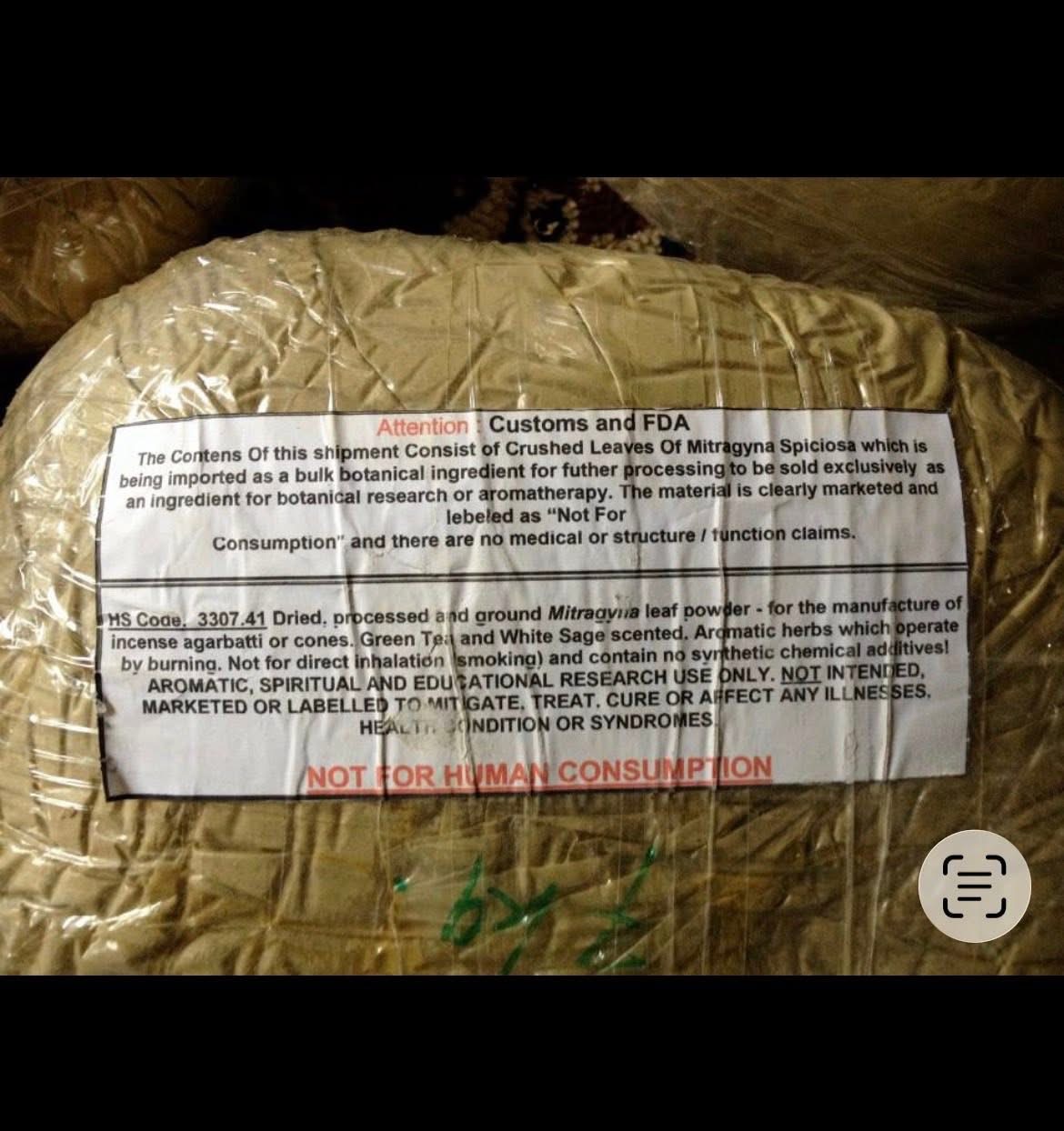
Such labels appear in public records and are part of a larger evidentiary picture. They do not automatically prove or disprove anything; they are one data point among many.
In FDA regulation, intended use is not determined solely by one sentence printed on a shipping document. FDA may examine labeling, advertising, websites, promotional claims, product form, instructions, and other surrounding evidence.
FDA warning letters repeatedly use website and social-media claims to establish the intended use of kratom products as drugs.
No single item automatically proves the intended use of every shipment. The question becomes stronger when multiple forms of evidence point in the same direction.
The goal of this investigation is not to rely on any single document, but to compare independent sources describing the same product, supplier, importer, and shipment.
Caution: Import-database summaries may truncate, concatenate, or omit words. Whenever possible, this series relies on the raw cargo description or the underlying shipment document rather than a shortened database label.
This is especially important because the workbook found examples where ImportYeti's shortened text appeared to drop "not" or merge contradictory phrases.
FDA Import Alert 54-15
FDA Import Alert 54-15 concerns dietary supplements and bulk dietary ingredients that are or contain kratom. Products from firms on the alert's Red List may be detained without physical examination; similar products from firms not yet listed may be referred for Center Review Detention. The alert also tells FDA personnel to consider labeling, marketing, and promotion that may indicate an unapproved or misbranded drug.
A "not for human consumption" statement may be relevant evidence, but it does not by itself establish that FDA lacked jurisdiction or that the material had no consumptive intended use.
Evidence comes from multiple sources. No single record is conclusive; the inquiry becomes stronger when multiple forms of evidence align.
Evidence may include:
Look for:
Look for:
Also relevant:
FDA currently states that kratom is not lawfully marketed as a dietary supplement, conventional food additive, or approved drug product in the United States.
For each supplier or importer, the evidence can be organized in a five-step chain:
Evidence labels: Shipping record · Package label · Website · Retail product · Inference
This template becomes the standard investigative framework for every importer.
This graphic illustrates how independent sources can be linked to build a case for intended use.
Each link in the chain provides a piece of the evidentiary puzzle. The strongest cases connect multiple links directly to the same shipment.
For every major Indonesian exporter, investigate:
Important: A supplier's general marketing does not prove the intended use of every shipment. The evidentiary value becomes stronger when the supplier, product form, time period, importer, and shipment can be directly connected.
Shipping records alone do not establish:
They can establish:
The question is not whether a shipment contains the words "Not for Human Consumption." The question is whether the complete body of evidence—including shipping records, package labeling, websites, product form, retail marketing, and downstream distribution—describes a product that was ultimately intended for human consumption.
A disclaimer is evidence. It is not necessarily the end of the inquiry.
When a shipment described as "not for human consumption" is connected to consumer packaging, serving directions, ingestible products, or suppliers openly marketing kratom for use by people, the discrepancy warrants closer review.
The public shipping records identify the question. FDA, CBP, importer records, commercial invoices, entry documents, and downstream distribution records are needed to answer it.