Real‑world exposure data from U.S. poison centers. National surveillance of kratom‑related toxicity, healthcare utilization, and pediatric exposures.
U.S. poison control centers have documented increasing kratom‑related exposures involving:
These reports provide insight into real‑world healthcare encounters associated with kratom‑containing products.
Total case mentions (2019–2024): 8,555 | Single‑substance exposures: 5,328
Source: America's Poison Centers® NPDS Annual Reports, Appendix B (Table 22A/22B). 2024 data preliminary.
| Year | None | Minor | Moderate | Major | Death | Total known |
|---|---|---|---|---|---|---|
| 2019 | 63 | 203 | 275 | 78 | 3 | 622 |
| 2020 | 59 | 175 | 259 | 66 | 5 | 564 |
| 2021 | 69 | 213 | 305 | 67 | 4 | 658 |
| 2022 | 66 | 167 | 248 | 55 | 3 | 539 |
| 2023 | 60 | 184 | 305 | 70 | 5 | 624 |
| 2024 | 92 | 233 | 332 | 76 | 7 | 740 |
2023 “New & Emerging” Findings (NPDS):
Source: 2023 NPDS Annual Report “Emerging Threats” analysis of kratom, phenibut, tianeptine, and nitrous oxide.
| Year | <5 yrs | 6–12 yrs | 13–19 yrs | Total Peds |
|---|---|---|---|---|
| 2019 | 60 | 3 | 39 | 102 |
| 2020 | 63 | 5 | 35 | 103 |
| 2021 | 91 | 5 | 43 | 139 |
| 2022 | 67 | 3 | 37 | 107 |
| 2023 | 71 | 3 | 32 | 106 |
| 2024 | 107 | 6 | 37 | 150 |
Children under five represent the largest pediatric exposure group each year. 2024 saw a record 107 cases in this age group.
After relative stability in 2019–2020, exposures increased sharply in 2021, declined modestly in 2022–2023, and reached a new high in 2024. Exposures among ages 6–12 remain low and stable. Adolescent exposures fluctuate moderately but do not show the same upward trajectory observed in the youngest age group.
Total pediatric exposures increased from 102 (2019) to 150 (2024). The majority of this increase is attributable to children under five.
Neonatal note: Neonatal withdrawal cases are often managed in hospitals without poison center involvement; actual prenatal exposure burden may be undercounted in NPDS.
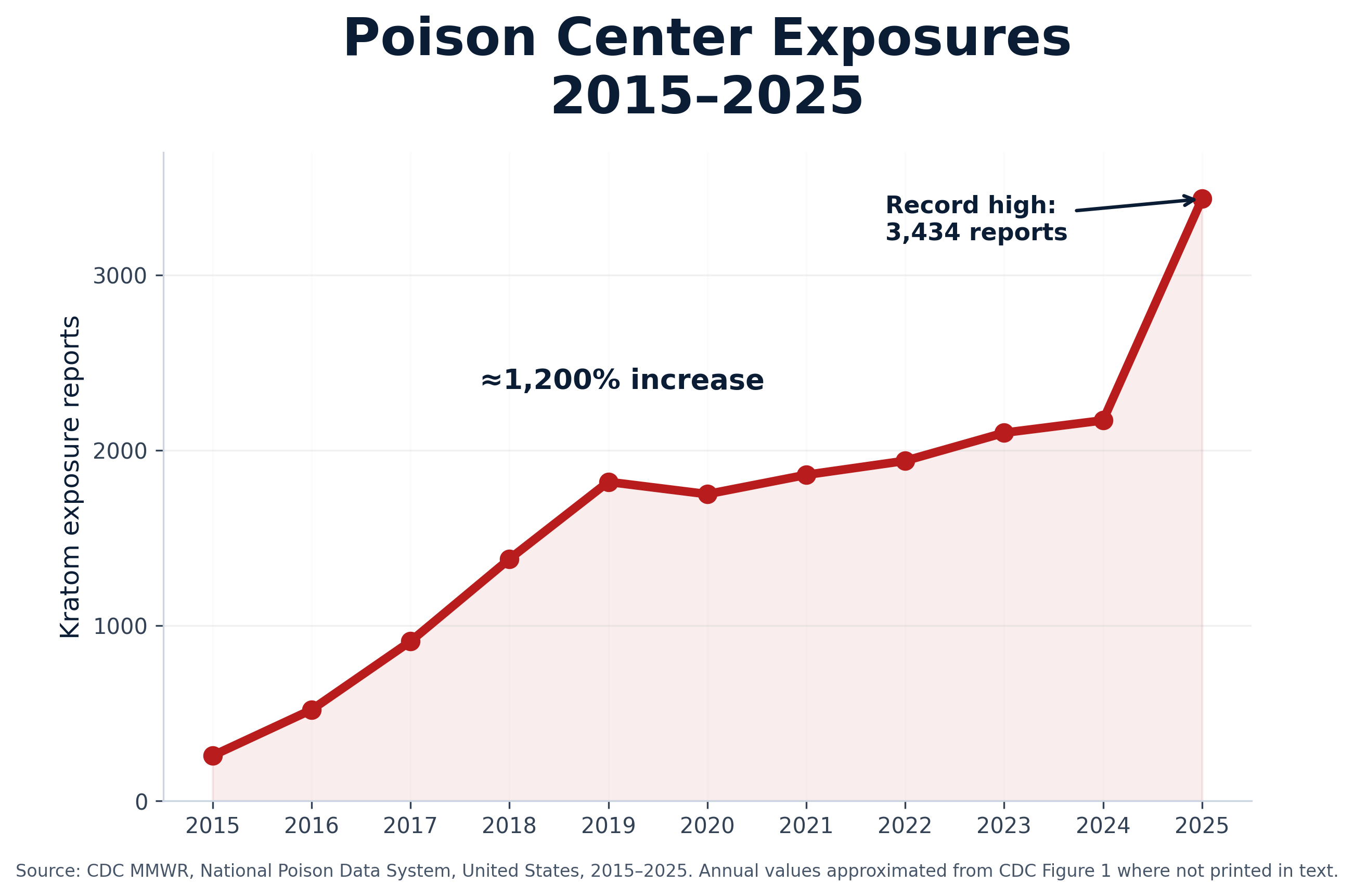
CDC reports a 1,200% increase in kratom exposures (258 → 3,434) with 79% of deaths involving polysubstance use. The 2025 spike coincides with high‑potency 7‑OH products, illustrating the escalating public health threat and the need for regulatory oversight.
Read Study →1,807 kratom exposures; 65% occurred 2016–2017. 31.8% admitted to healthcare facility, 51.9% serious medical outcome. Common effects: agitation (22.9%), tachycardia (21.4%), seizures (9.6%), coma (3.2%). 11 deaths (2 with kratom alone).
Read Study →4.6% of 3,484 exposures in adults ≥60. Among ≥70 years, 21.9% adverse reactions (drug interactions) vs 9.6% in younger adults. 23 deaths. Highlights vulnerability of elderly population.
Read Study →36‑year‑old consumed >500g kratom; intubated, AST 1347, ALT 3717, renal injury, 7‑OH >500 ng/mL. Required 14 days ICU. Authors call kratom “legally lethal.”
View Case →Kratom exposures to poison centers increased from 26 (2010) to 263 (2015). 41.7% moderate effects, 7.4% major outcomes, one death. CDC declares “emerging public health threat.”
Read Report →Apnea, cyanosis, pinpoint pupils after high‑dose kratom; responded to naloxone but later rebound hypoxia. Highlights opioid‑like toxidrome and need for 24h observation.
Read Case →90% depressed consciousness; naloxone prevented intubation in two cases. Confirms opioid‑like toxidrome and response to naloxone.
Read Study →15‑year‑old ingested 45 capsules (22.5g) as suicide attempt. Tachycardia, miosis, tremors, hypokalemia, QTc 474 ms. Resolved with supportive care.
Read Case →Surveillance note:
Poison center data are spontaneous reports; they do not capture all exposures, and under‑reporting is likely. However, the consistent upward trend, rising severity, and increasing pediatric cases provide a strong population‑level signal of real‑world harm. These data are used by health departments, medical toxicologists, and legislative committees to identify emerging public health threats.